William Golding’s Lord of the Flies explores human nature, fear, leadership, power, morality, and the struggle between social order and violence. The quotes from Lord of the Flies remain memorable because they reveal how people can behave when familiar rules, responsibilities, and social expectations begin to disappear.
Published in 1954, the novel follows a group of schoolboys stranded on an island without adults. At first, they attempt to create rules, communicate with one another, and work toward rescue. As fear and conflict increase, however, their community begins to change.
Golding uses the boys’ experiences to examine difficult questions about human behavior. Who should have authority? Why do people follow groups? How does fear affect judgment? What happens when individuals stop feeling responsible for their actions?
These questions give the novel lasting value for students and literature readers. Below, the most meaningful quotations are discussed through their context, symbolism, and connection to the novel’s major themes.
Famous Quotes from Lord of the Flies and Their Meanings
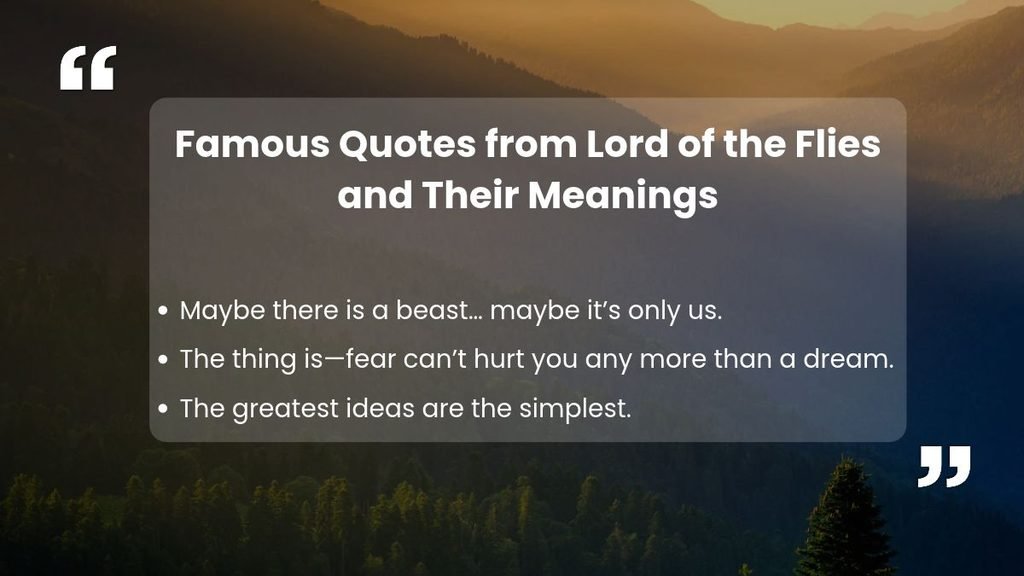
“Maybe there is a beast… maybe it’s only us.”
Simon expresses one of the novel’s most important ideas when he suggests that the feared beast may not be an outside creature at all.
The boys initially imagine that something dangerous is hiding on the island. As the story develops, Simon begins to understand that the real threat is connected to their own fear and behavior.
This idea changes the way readers understand the entire story. The beast becomes more than something the boys fear. It represents the possibility of darkness within human behavior.
Meaning: Fear can become more powerful when people misunderstand its source.
Life lesson: When facing uncertainty, examine your own assumptions before allowing fear to control your decisions.
“The thing is fear can’t hurt you any more than a dream.”
Ralph tries to reassure the other boys that fear itself does not have the same power as a physical danger. Yet the story shows that fear can still influence people strongly.
The boys become increasingly affected by what they believe about the beast. Their fear changes their decisions and contributes to conflict within the group.
Golding therefore presents fear as a psychological force. Something does not have to be physically present to influence behavior.
Meaning: Fear can affect judgment even when its source is uncertain.
Life lesson: Calm thinking can help people respond more wisely when emotions are intense.
“The greatest ideas are the simplest.”
This idea connects with the novel’s treatment of reason and practical thinking. Piggy frequently encourages the boys to use logic and consider workable solutions.
The story also shows that useful ideas are not always respected. A person may have a sensible solution, yet others may ignore it because of personality, popularity, or group pressure.
Meaning: The value of an idea comes from what it accomplishes, not from who presents it.
Life lesson: Listen carefully to useful ideas, even when they come from someone who is not popular.
Quotes About Rules and Social Order
“We’ve got to have rules and obey them.”
The boys understand early in the story that they need rules if they want to work together. The conch becomes an important symbol of this agreement because it helps organize meetings and gives people an opportunity to speak.
As the story progresses, fewer boys respect the rules. This change shows that a community cannot depend on rules alone. People must also believe that cooperation and responsibility are worth protecting.
Meaning: Social order requires shared responsibility.
Life lesson: Rules work best when people understand their purpose and respect their effect on others.
“The rules! You’re breaking the rules!”
Ralph repeatedly reminds the group about the agreements they made. His concern reflects his desire to preserve communication and cooperation.
The conflict surrounding the rules becomes a sign of the group’s growing division. Once people stop respecting shared agreements, maintaining order becomes much harder.
Meaning: A system cannot remain strong when its members no longer respect its basic principles.
Life lesson: Communities depend on trust, cooperation, and respect for shared standards.
“Which is better—to have rules and agree, or to hunt and kill?”
Piggy’s question presents the central choice facing the boys. They can continue working together through discussion and agreed rules, or they can allow aggression and personal power to dominate.
Golding uses this conflict to explore how communities respond when cooperation becomes difficult.
Meaning: Peaceful cooperation requires people to control destructive impulses.
Life lesson: Stability depends on responsibility, restraint, and respect for others.
Quotes About Human Nature
“Ralph wept for the end of innocence…”
The ending of the novel gives this idea enormous importance. Ralph has survived the events on the island, but he has also learned something painful about human behavior.
The loss of innocence is connected to Ralph’s realization that people can make cruel choices when fear, pressure, and power influence them.
Golding does not present human beings as simply good or bad. Instead, the novel examines the difficult relationship between personal choice and social influence.
Meaning: Understanding human weakness can be painful but important.
Life lesson: Recognizing our own weaknesses can help us make more responsible choices.
“The mask was a thing on its own…”
Jack’s painted face becomes a powerful symbol of changing identity. Behind the mask, he feels separated from the expectations that previously restrained him.
The mask allows Golding to explore anonymity and personal responsibility. When people feel hidden from judgment, they may behave differently.
Meaning: A hidden identity can make people feel less accountable for their actions.
Life lesson: Personal responsibility matters even when other people cannot see what you are doing.
“Kill the pig…”
The hunters’ chant demonstrates the influence of group behavior. Repetition, excitement, and shared emotion gradually affect how the boys behave.
The scene is important because it shows how individuals can become influenced by a group atmosphere. Actions that might seem unacceptable to one person can feel different when everyone around them is participating.
Meaning: Group pressure can weaken individual judgment.
Life lesson: Think independently instead of following a crowd without considering the consequences.
Quotes About Leadership and Power
Ralph and the conch
The conch is one of the novel’s most important symbols. Ralph uses it to call meetings and establish a system in which members of the group can speak.
Its authority comes from shared agreement. The boys initially accept its importance because they want an organized way to communicate.
As the group becomes divided, the conch gradually loses its influence. This change reflects the weakening of the social structure Ralph represents.
Meaning: Authority becomes stronger when people recognize and respect it.
Life lesson: Effective leadership involves listening, communication, and accountability.
Jack’s changing approach to leadership
Jack increasingly relies on hunting, fear, and personal influence. His leadership style contrasts with Ralph’s focus on meetings, rules, and rescue.
The difference between them allows Golding to explore two competing approaches to authority. One depends more heavily on cooperation and discussion, while the other increasingly depends on strength and control.
Meaning: Leadership can shape the values and behavior of an entire group.
Life lesson: Influence should be accompanied by responsibility and consideration for others.
Piggy and the value of reason
Piggy represents logic, knowledge, and practical thinking. He frequently encourages the boys to plan carefully and consider evidence.
Although his ideas can be useful, the others do not always respect him. This reveals another important theme: people do not always value intelligence when it conflicts with popularity or physical strength.
Meaning: Good reasoning can be ignored when a group values other qualities more highly.
Life lesson: Consider an argument carefully instead of judging it according to the speaker’s popularity.
Quotes About Fear and the Beast
Fear is one of the strongest forces in Lord of the Flies. The boys’ uncertainty about the beast gradually affects their decisions and relationships.
The beast as a symbol
The beast is not simply a frightening idea within the story. It becomes a symbol of fear, uncertainty, and the darker possibilities of human behavior.
Simon’s understanding of the beast is important because he begins to recognize that the boys may be afraid of something connected to themselves.
This interpretation helps explain why the beast becomes so powerful. The boys’ belief in it affects their behavior, even though their understanding of it is incomplete.
Meaning: Fear can gain power when people allow uncertainty to shape their decisions.
Life lesson: Question frightening assumptions and seek understanding before acting on panic.
Important Symbols in Lord of the Flies
Understanding the novel’s symbols makes its quotations easier to analyze.
The Conch
The conch represents communication, shared authority, and social order. Its changing importance reflects the group’s changing relationship with rules.
The Beast
The beast represents fear and the darker possibilities within human behavior. The boys’ belief in it demonstrates how fear can influence a community.
The Pig’s Head
The pig’s head, known as the Lord of the Flies, represents the disturbing side of human behavior and the growing influence of violence.
The Signal Fire
The signal fire represents rescue, hope, and the boys’ connection with the society they left behind. Their changing attitude toward the fire reveals their changing priorities.
The Painted Mask
The painted mask represents anonymity and the reduced sense of responsibility that can occur when people feel separated from their usual identity.
Why Lord of the Flies Quotes Still Matter
The ideas in Lord of the Flies remain useful because the novel asks broad questions about how people behave within groups.
Its major themes include:
- Human nature: People can make both caring and harmful choices.
- Leadership: Different approaches to authority can affect an entire group.
- Fear: Uncertainty can influence judgment.
- Social order: Communities depend on shared rules and cooperation.
- Power: Authority can become harmful when accountability disappears.
- Group pressure: People may behave differently when influenced by a crowd.
- Responsibility: Individual decisions can affect other people.
These themes make the novel useful for literary analysis as well as personal reflection.
What Readers Can Learn from Lord of the Flies
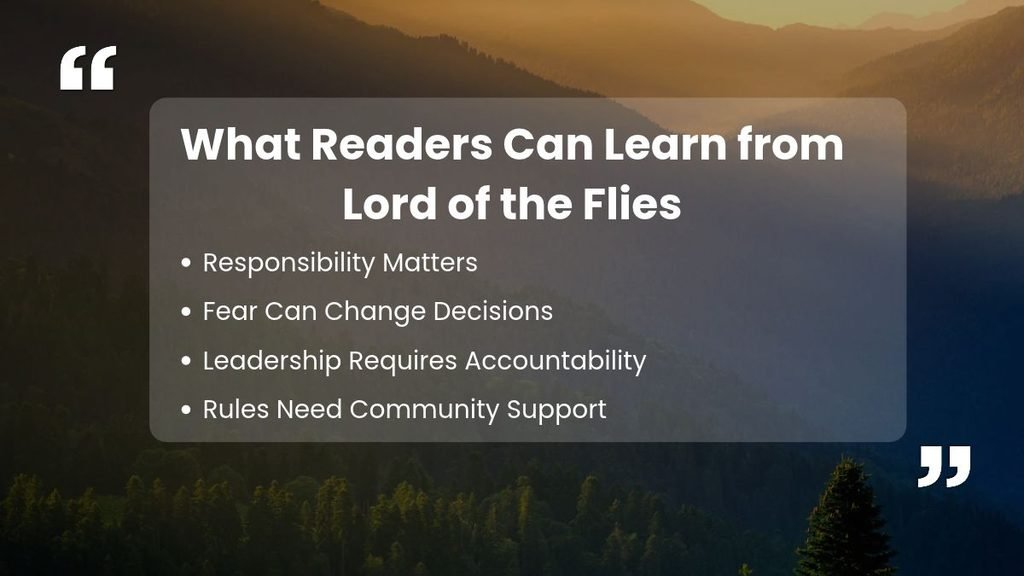
Responsibility Matters
Freedom does not remove responsibility. The boys still need to consider how their decisions affect one another, even when there are no adults present.
Fear Can Change Decisions
The boys’ fear of the beast demonstrates how uncertainty can affect judgment. Fear becomes especially powerful when people stop questioning their assumptions.
Leadership Requires Accountability
Ralph, Jack, Piggy, and Simon provide different perspectives on authority, reason, and influence. Their experiences show why leadership cannot be separated from responsibility.
Rules Need Community Support
Rules have little effect when people no longer respect them. A functioning community requires cooperation as well as agreed standards.
Group Pressure Can Affect Individuals
The novel shows how people can be influenced by shared excitement, fear, and pressure. Independent thinking becomes especially important when emotions are strong.
How to Use Lord of the Flies Quotes in an Essay
Students should not place a quotation in an essay without explaining its purpose. A strong literary paragraph connects evidence to a clear argument.
A useful structure is:
Claim → Evidence → Context → Analysis → Connection to the theme
For example, if an essay discusses fear, the student can introduce a brief quotation, explain who says it, describe the situation, and then analyze how Golding uses the language to develop the theme.
The analysis should do more than repeat the quotation. It should explain why the words matter and how they contribute to the reader’s understanding of the novel.
Frequently Asked Questions
What are the most important quotes from Lord of the Flies?
Important quotations explore the beast, fear, rules, leadership, power, and human nature. Their significance comes from how they connect with the novel’s central themes.
What is the main message of Lord of the Flies?
The novel examines how social order can weaken when rules, authority, cooperation, and shared values lose their influence. It also explores fear, power, morality, and human behavior.
What does the beast represent in Lord of the Flies?
The beast represents fear and the darker possibilities of human behavior. Although the boys initially imagine an external creature, its deeper meaning is connected with their own actions and fears.
What does the conch symbolize?
The conch symbolizes communication, shared authority, and social order. Its declining influence reflects the breakdown of the group’s agreements.
Why is Piggy important in Lord of the Flies?
Piggy represents reason, knowledge, and practical thinking. His treatment by the other boys also shows how useful ideas can be ignored when a group values popularity or physical strength.
What does the signal fire represent?
The signal fire represents rescue, hope, and the boys’ connection with the society they left behind. Its importance changes as the boys’ priorities change.
How does Lord of the Flies explore human nature?
Golding places ordinary children in an unusual situation and examines how fear, group pressure, power, and the loss of familiar structures affect their behavior.
How should students use Lord of the Flies quotes in essays?
Students should use short quotations as evidence for a clear argument. They should explain the context, analyze the language, and connect the quotation to a relevant theme or literary technique.
Conclusion
The most memorable quotes from Lord of the Flies reveal important ideas about human nature, fear, leadership, power, responsibility, and social order.
Golding’s novel is more than a story about children stranded on an island. It asks readers to consider what keeps communities together and what can happen when people stop respecting shared rules and responsibilities.
The quotations become even more meaningful when they are studied alongside the novel’s symbols, characters, and themes. Rather than memorizing individual lines, readers can consider who says each statement, what is happening at that moment, and how Golding develops his larger ideas.
Ultimately, Lord of the Flies encourages readers to think carefully about their choices, their influence on others, and the responsibilities that come with living as part of a community.
