
Paul Revere quotes are often associated with courage, freedom, patriotism, leadership, and one of the most famous journeys in American history. His midnight ride in April 1775 has become a lasting symbol of warning, preparation, and determination.
However, there is an important historical detail to understand before reading a collection of Paul Revere quotes. Many lines commonly found online under his name were never actually spoken or written by Revere. Some come from Henry Wadsworth Longfellow’s famous poem Paul Revere’s Ride, while others are later sayings with uncertain or unsupported attribution.
Paul Revere himself left accounts of his famous journey. These firsthand accounts provide valuable evidence about what happened on the night of April 18–19, 1775. The National Park Service also explains that the popular version of the ride differs from the historical record in several important ways. Revere did not ride all the way to Concord, he did not travel alone, and British troops eventually captured him near Lincoln.
That makes Revere’s story especially interesting. His real historical record is already powerful without adding words that he never said.
In this article, you will find documented words associated with Paul Revere, famous lines from Longfellow’s poem, historical context, lessons from his journey, and answers to common questions about Paul Revere quotes.
Famous Paul Revere Quotes and Documented Words
Paul Revere was not primarily known as a writer of inspirational quotations. His historical importance comes from his actions, political activities, correspondence, and accounts of the events surrounding Lexington and Concord.
When discussing his words, it is therefore important to distinguish documented statements from later interpretations.
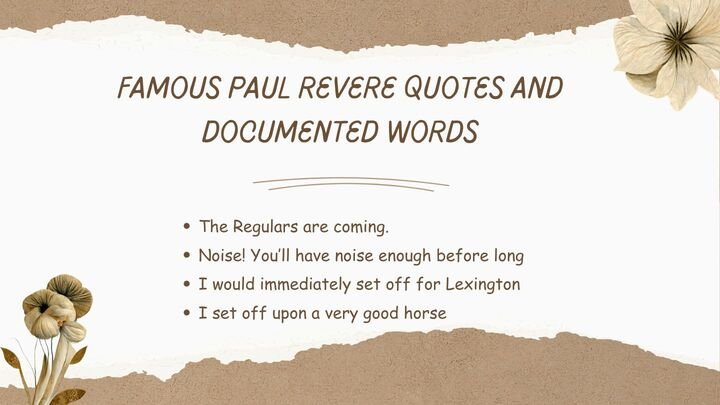
“The Regulars are coming.”
This statement is closely connected with Revere’s arrival at Lexington during the warning mission.
The word “Regulars” referred to British regular troops. Revere was trying to communicate that British soldiers were moving toward the area.
The statement is historically significant because it reflects the immediate purpose of his journey. He was carrying information that could give local people time to respond.
The National Park Service records the warning as part of the events at Lexington and identifies Revere’s role in spreading the alarm before the British advance.
“Noise! You’ll have noise enough before long.”
This statement is associated with Revere’s arrival at Lexington.
According to historical accounts, Sergeant William Munroe asked Revere not to make so much noise because people were sleeping. Revere responded that there would soon be enough noise because the British regulars were approaching.
The statement gives us a glimpse of the urgency surrounding the night.
Instead of treating courage as a vague idea, this moment shows how Revere responded when people needed important information quickly.
“I would immediately set off for Lexington.”
Revere’s own account describes his intention to travel toward Lexington after receiving information about the British movement.
This statement helps explain the practical purpose of his journey. He was not simply looking for adventure. He was carrying a warning to people who could be affected by the approaching troops.
“I set off upon a very good horse.”
Revere described beginning his journey after obtaining a horse.
The sentence may seem simple, but it is useful because it comes from the historical account of the ride rather than from a later poem.
It reminds readers that famous historical events often involved ordinary practical details: finding transportation, communicating with others, choosing routes, and responding to unexpected obstacles.
Paul Revere Quotes About Courage
Courage is one of the qualities most strongly connected with Paul Revere.
His journey occurred during a period of serious political tension. British authorities were attempting to control revolutionary activity, while colonial leaders and their supporters were organizing resistance.
Revere’s role required him to move through the countryside at night while British patrols were active.
Courage Means Acting When Information Matters
One lesson from Revere’s story is that courage can involve acting quickly when other people depend on accurate information.
The warning was valuable because it gave communities time to prepare.
Revere did not know exactly how the night would unfold. He nevertheless continued his mission until British officers stopped him.
Courage Is Not Always a Solo Achievement
The popular image of Revere often makes him appear to be the only rider involved.
The historical record tells a broader story.
William Dawes was also sent from Boston, and Samuel Prescott later joined Revere and Dawes. When the three encountered a British patrol, Revere was captured, Dawes escaped, and Prescott continued toward Concord.
This makes the story a useful reminder that courage can exist within a team.
Courage and Responsibility
Revere’s story also connects courage with responsibility.
His task was not simply to travel quickly. He had to deliver information that other people could use.
That kind of responsibility requires attention, preparation, and persistence.
Paul Revere Quotes About Freedom
Paul Revere lived during a period when arguments about political authority, rights, representation, and liberty were becoming increasingly intense.
Because of that historical setting, his name is often connected with freedom.
However, many inspirational statements about liberty that appear online under Revere’s name are difficult to verify.
“The cause of liberty is a cause worth fighting for.”
This sentence is sometimes presented as a Paul Revere quotation.
It should not, however, be treated as an authenticated quotation without a reliable primary source.
The general theme of liberty certainly belongs to the history of the American Revolution, but a historical idea and a documented quotation are not the same thing.
Freedom Through Historical Action
A more reliable way to discuss Revere and freedom is to examine what he actually did.
He participated in the revolutionary movement and became involved in the political and military developments surrounding Massachusetts.
His midnight ride was part of a larger effort to resist British military action and warn communities about the movement of troops.
Liberty and Responsibility
Revere’s story also shows that political freedom is connected with responsibility.
The warning network required people to watch, communicate, travel, and respond.
Whatever one’s interpretation of the Revolution, the historical record demonstrates that political conflicts can involve ordinary people making serious choices.
Paul Revere Quotes About Leadership
Paul Revere’s story offers several useful lessons about leadership without requiring us to invent quotations.
His role depended on communication, preparation, cooperation, and initiative.
Leadership Through Action
Revere’s importance did not come from holding the highest political office.
Instead, he became valuable because he was willing to carry out an important task.
Leadership can sometimes involve taking responsibility for a specific job and completing it effectively.
Leadership Through Communication
Communication was at the center of the warning effort.
Revere and other Patriots used messengers and signals to spread information about British movements.
The lantern signal associated with the Old North Church became famous because it represented a planned method of communication.
The National Park Service explains that the popular version of the lantern story differs from the actual sequence of events. The signals were a backup plan rather than the simple starting point portrayed in Longfellow’s poem.
Leadership Through Preparation
The warning network did not suddenly appear when the British troops began moving.
Patriot leaders had already established systems for watching British activity and spreading warnings.
The National Park Service describes a broader system involving watches, couriers, and local messengers.
This historical detail is important because it shows that successful action often depends on preparation before an emergency begins.
Paul Revere Quotes About Patriotism
Paul Revere is frequently remembered as a Patriot of the American Revolution.
In the historical context of the time, “Patriot” referred to colonists who supported resistance to British authority.
Patriotism Through Service
Revere contributed to the revolutionary cause through several forms of service.
His work as a messenger during the Lexington and Concord warning effort became the part of his life that later generations remembered most strongly.
Patriotism and Historical Context
It is useful to remember that people in the eighteenth century did not all share the same political views.
The American Revolution involved Patriots, Loyalists, and many people whose positions were more complicated than either label suggests.
Therefore, an accurate article about Revere should explain the historical context rather than reduce the entire period to a collection of modern motivational slogans.
A Famous Patriotism Quote That Is Not Revere’s
The saying “Patriotism is supporting your country all the time, and your government when it deserves it” is commonly attributed to Mark Twain.
It is not a Paul Revere quotation.
Including a quotation from another historical figure can be useful in an article about patriotism, but the attribution should always remain clear.
Famous Lines From Henry Wadsworth Longfellow’s Paul Revere’s Ride
Some of the most recognizable Paul Revere quotes are actually lines from Henry Wadsworth Longfellow’s poem.
This distinction is essential.
Longfellow’s poem was published in 1860 and later included in Tales of a Wayside Inn. The National Park Service explains that the poem became extremely influential but also took significant poetic license with the historical events.
“Listen, my children, and you shall hear”
This famous opening introduces Longfellow’s poetic version of the midnight ride.
The line is memorable because it presents the story as something worth passing from one generation to another.
It is a literary statement by Longfellow, not a quotation from Paul Revere.
“One if by land, and two if by sea”
This is perhaps the most famous line associated with the lantern signal.
Longfellow used it to create a dramatic moment in the poem.
There was a real lantern signaling system, but the actual circumstances were more complicated than the poem suggests. The National Park Service notes that Revere already knew the British route before leaving Boston and that the lanterns were intended as a backup signal.
“Hardly a man is now alive”
This line reflects the passage of time between the events of 1775 and Longfellow’s nineteenth-century retelling.
By writing the poem decades after the Revolution, Longfellow helped transform a historical event into a story remembered by new generations.
“The fate of a nation was riding that night”
Longfellow’s poem presents the ride in dramatic terms.
The line expresses the poet’s interpretation of the importance of the event rather than words spoken by Revere.
This is an excellent example of why readers should identify the difference between historical documents and literary works.
How Longfellow Changed the Paul Revere Story
Longfellow played a major role in creating the popular image of Paul Revere.
The poem is memorable, rhythmic, and dramatic. It focuses heavily on Revere and presents the ride as a heroic journey through the night.
The historical record is more complicated.
Revere was one of several people spreading the alarm. He did not reach Concord. British troops captured him near Lincoln, and Samuel Prescott continued toward Concord.
The National Park Service explicitly describes Longfellow’s poem as a myth or tale rather than a precise historical account.
That does not make the poem unimportant.
Literature can shape cultural memory in powerful ways. Longfellow’s poem helped preserve the story of the Revolution for millions of readers, even though the poem should not be used as the only source for understanding what happened.
What Actually Happened During Paul Revere’s Midnight Ride?
Understanding the real sequence of events makes the famous story even more interesting.
The Mission Begins in Boston
On the evening of April 18, 1775, Dr. Joseph Warren directed Paul Revere and William Dawes to travel toward Lexington.
Their task was to warn John Hancock and Samuel Adams about the approaching British troops.
Revere had already been involved in gathering information about British movements.
The mission therefore formed part of a larger intelligence and warning effort.
Revere Crosses the River
Revere left Boston and traveled toward Charlestown.
A signal involving lanterns at the Old North Church was available if needed to communicate the British movement.
However, contrary to the famous poem, Revere was not simply waiting across the water to see the signal before learning the route. The National Park Service identifies the lanterns as a backup plan.
Revere Reaches Lexington
Revere traveled toward Lexington and eventually reached the home where John Hancock and Samuel Adams were staying.
He delivered the warning.
William Dawes also arrived, and the two decided to continue the warning effort toward Concord.
Samuel Prescott Joins the Riders
On the road, Revere and Dawes encountered Dr. Samuel Prescott.
Prescott knew the area and joined them as they continued toward Concord.
This is one of the most important details missing from the popular image of the ride.
The famous story is not really about one rider. It is about a network of people spreading an urgent message.
The British Patrol Intervenes
The riders encountered a British patrol near Lincoln.
Revere was captured.
William Dawes escaped by turning back toward Lexington, while Samuel Prescott managed to escape and continued toward Concord.
This means Revere did not personally complete the journey to Concord.
Revere Is Released
British officers eventually released Revere, but they took his horse.
He returned on foot toward Lexington.
By then, the situation had developed into open conflict.
The warning network had already done its work, and alarms were spreading throughout the countryside.
Paul Revere and the Other Midnight Riders
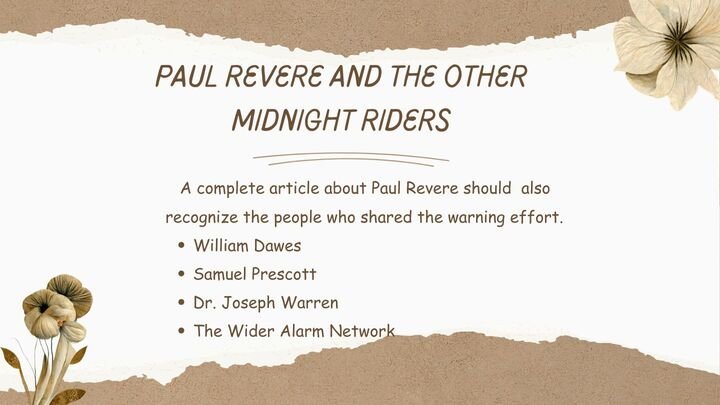
A complete article about Paul Revere should also recognize the people who shared the warning effort.
William Dawes
William Dawes was another Patriot messenger sent from Boston toward Lexington.
He traveled by a different route from Revere.
The popular poem largely leaves him out, but historical records show that he played an important role.
Samuel Prescott
Samuel Prescott was a physician from Concord who joined Revere and Dawes after they reached Lexington.
When the three riders encountered the British patrol, Prescott escaped and continued toward Concord.
Because of this, Prescott was particularly important in carrying the warning farther west.
Dr. Joseph Warren
Dr. Joseph Warren played a key role in directing the warning mission.
The National Park Service identifies Warren as the revolutionary leader who ordered Revere and Dawes to ride toward Lexington.
The Wider Alarm Network
The warning did not depend only on three riders.
A larger system of watches, messengers, local officials, militia members, and community networks helped spread information.
The National Park Service describes this wider organization as part of the Patriot effort to alert the countryside.
Why Paul Revere Did Not Ride Alone
The image of a lone rider has become one of the most famous parts of the story.
Longfellow’s poem helped strengthen that image.
Historical evidence tells us something different.
Revere was one part of a larger communication system. William Dawes traveled another route, Samuel Prescott continued the warning after Revere’s capture, and many local messengers helped spread the alarm.
This does not make Revere’s role less important.
Instead, it provides a more accurate understanding of how communication worked during the Revolution.
Large historical events are often created through the combined efforts of many people.
Why Paul Revere Quotes Are Often Misattributed
The internet contains hundreds of quotation pages, but not every quotation has a reliable historical source.
Quotes From Longfellow
The easiest mistake is confusing Longfellow’s words with Revere’s.
Lines such as “Listen, my children, and you shall hear” belong to Longfellow’s poem.
Modern Motivational Sayings
Other websites attach general motivational statements about courage or freedom to Revere without providing a primary source.
These should be treated cautiously.
A quotation that sounds appropriate for a historical figure is not automatically authentic.
Historical Retellings
Stories often change when they are repeated.
Details may become simplified, dramatic moments may receive greater attention, and secondary sources may repeat earlier mistakes.
That is why primary documents and reputable historical institutions are particularly useful when researching historical quotations.
What Makes Paul Revere’s Own Accounts Important?
Revere wrote accounts of his ride, giving historians direct evidence from the person at the center of the story.
The National Park Service notes that Revere wrote three accounts of the famous ride, including an account produced soon after the event and a more detailed letter written later.
These documents are valuable because they allow historians to compare Revere’s own description with later stories.
They also show why history is not always as simple as a famous poem makes it appear.
Lessons From Paul Revere’s Story
The historical story of Paul Revere provides several useful lessons without requiring questionable quotations.
Preparation Can Matter Before a Crisis
The warning system had already been planned before the British troops began their movement.
The lanterns, watches, couriers, and messengers were part of a broader preparation effort.
This shows why preparation matters when people expect that a difficult situation may develop.
Communication Can Change What People Do
The purpose of the ride was to spread information.
The message allowed local communities to prepare for the approaching troops.
The story demonstrates the importance of getting useful information to the right people at the right time.
Teamwork Can Be More Important Than Fame
Revere became the best-known name connected with the warning, but the historical effort involved many people.
Dawes, Prescott, Warren, local messengers, and community members all played different roles.
This is a valuable reminder that historical recognition does not always reflect the number of people who contributed.
Historical Accuracy Matters
Perhaps the most important lesson for modern readers is the need to check sources.
The famous version of the midnight ride is memorable, but the documented history is more complex.
Reading primary sources can reveal details that popular stories leave out.
How to Use Paul Revere Quotes in a History Project
Identify the Speaker
Before using a quotation, check whether it was actually spoken or written by Revere.
If it came from Longfellow, identify Longfellow as the author.
Give Historical Context
Do not place a historical quotation on a page without explaining what was happening when the words were used.
Context helps readers understand why the words mattered.
Use Reliable Sources
The Library of Congress and National Park Service provide historical resources that can help students investigate Revere’s story and the events of Lexington and Concord.
Avoid Unsupported Attributions
If a quotation cannot be traced to a reliable source, do not present it as an authentic Paul Revere quote.
It is better to have fewer verified quotations than a longer list filled with questionable material.
How to Use Paul Revere Quotes for Inspiration
Paul Revere’s story can still provide inspiration even when readers focus on historical accuracy.
For Courage
His willingness to continue carrying the warning despite uncertainty makes his story useful when discussing courage.
For Leadership
His role demonstrates the importance of taking responsibility and communicating information.
For Teamwork
The wider network of riders and messengers shows that major achievements often depend on cooperation.
For Learning From History
The difference between Longfellow’s poem and the historical record is itself an important lesson.
It shows how literature can influence the way people remember the past.
Frequently Asked Questions About Paul Revere Quotes
Who was Paul Revere?
Paul Revere was an American silversmith, engraver, businessman, and participant in the revolutionary movement in Massachusetts. He became famous for his role in the warning effort before Lexington and Concord.
What is Paul Revere most famous for?
He is most famous for his role in the midnight warning mission of April 18–19, 1775, when he and other messengers helped alert communities about the movement of British troops.
Did Paul Revere really say “The British are coming”?
The phrase is strongly associated with the popular story, but it should not be presented as a verified quotation from Revere.
Historical accounts instead connect him with warnings that the British “Regulars” were coming.
Who wrote “Listen, my children, and you shall hear”?
Henry Wadsworth Longfellow wrote the line in Paul Revere’s Ride. It is not a quotation from Paul Revere.
Who wrote “One if by land, and two if by sea”?
Henry Wadsworth Longfellow wrote the famous line as part of his poem. The poem was based on historical events but included poetic changes to the story.
Did Paul Revere ride all the way to Concord?
No. British officers captured Revere near Lincoln before he reached Concord. Samuel Prescott escaped and continued the warning toward Concord.
Did Paul Revere ride alone?
No. William Dawes was another rider sent from Boston, and Samuel Prescott later joined Revere and Dawes. The warning also involved a much larger network of people.
Why is Paul Revere still famous?
His historical role and Longfellow’s influential poem combined to make him one of the most recognizable figures associated with the American Revolution.
Did Paul Revere write many famous quotes?
No. His historical importance comes primarily from his actions, accounts, and revolutionary activities rather than from a large collection of famous quotations.
Why are Paul Revere quotes difficult to verify?
Some quotations come from Longfellow’s poem, some come from historical accounts, and others have been attributed to Revere without strong evidence.
Checking the original source helps separate documented words from later interpretations.
What can we learn from Paul Revere’s story?
His story can teach lessons about preparation, communication, courage, responsibility, teamwork, and the importance of checking historical sources.
Final Thoughts on Paul Revere Quotes
Paul Revere quotes are much more interesting when they are placed in their proper historical context.
Revere’s famous ride was not exactly the solitary midnight adventure presented in many popular retellings. He was part of a larger network of people who worked to spread an urgent warning about British troop movements.
He also did not complete the ride to Concord. British officers captured him near Lincoln, while William Dawes escaped and Samuel Prescott continued toward Concord.
The later fame of the story owes much to Henry Wadsworth Longfellow. His poem Paul Revere’s Ride gave the event a dramatic literary form and helped preserve Revere’s name in American cultural memory. The National Park Service, however, emphasizes that the poem contains significant differences from the historical record.
That difference between history and literature is one of the most valuable parts of the story.
When readers look beyond the famous lines, they find a more complicated and human history: messengers traveling through the night, local communities sharing information, planned warning systems, unexpected encounters, and several people working toward the same goal.
For anyone searching for Paul Revere quotes about courage, freedom, leadership, and patriotism, the strongest approach is to combine documented words with reliable historical context.
Revere’s own accounts help us understand what he experienced. Longfellow’s poem helps us understand how later generations remembered him.
Together, they show why Paul Revere remains such a memorable figure in American history—and why checking the source behind a famous quotation is just as important as the quotation itself.
